

Law Attorneys Get Started Today
How Does Child Support Work in Colorado?
Key Takeaways
- Child support exists to meet a child’s basic living and developmental needs.
- Colorado courts allow parents to create their own child support agreement first.
- A judge usually approves agreements unless they violate guidelines or the child’s interests.
- Courts decide support when parents cannot reach an agreement.
- Colorado calculates support using both parents’ combined gross incomes and statutory percentages.
Families going through divorce frequently ask How does child support work in Colorado? The answer centers on a formula based on each parent’s income, the number of overnights each parent has per year, and the child’s financial needs. As a Fort Collins Family Law Attorney, The Law Office of Stephen Vertucci, LLC, we serve northern Colorado families. We help parents understand their rights and obligations so both parties contribute fairly to a child’s upbringing.
Courts follow state guidelines to calculate support, though the final amount adjusts based on healthcare costs, childcare expenses, and shifts in either parent’s income over time. Colorado courts also have the authority to revisit a support order when a parent’s circumstances change or when payments stop.
Contact a Fort Collins Divorce Lawyer
What Is the Purpose of Child Support?
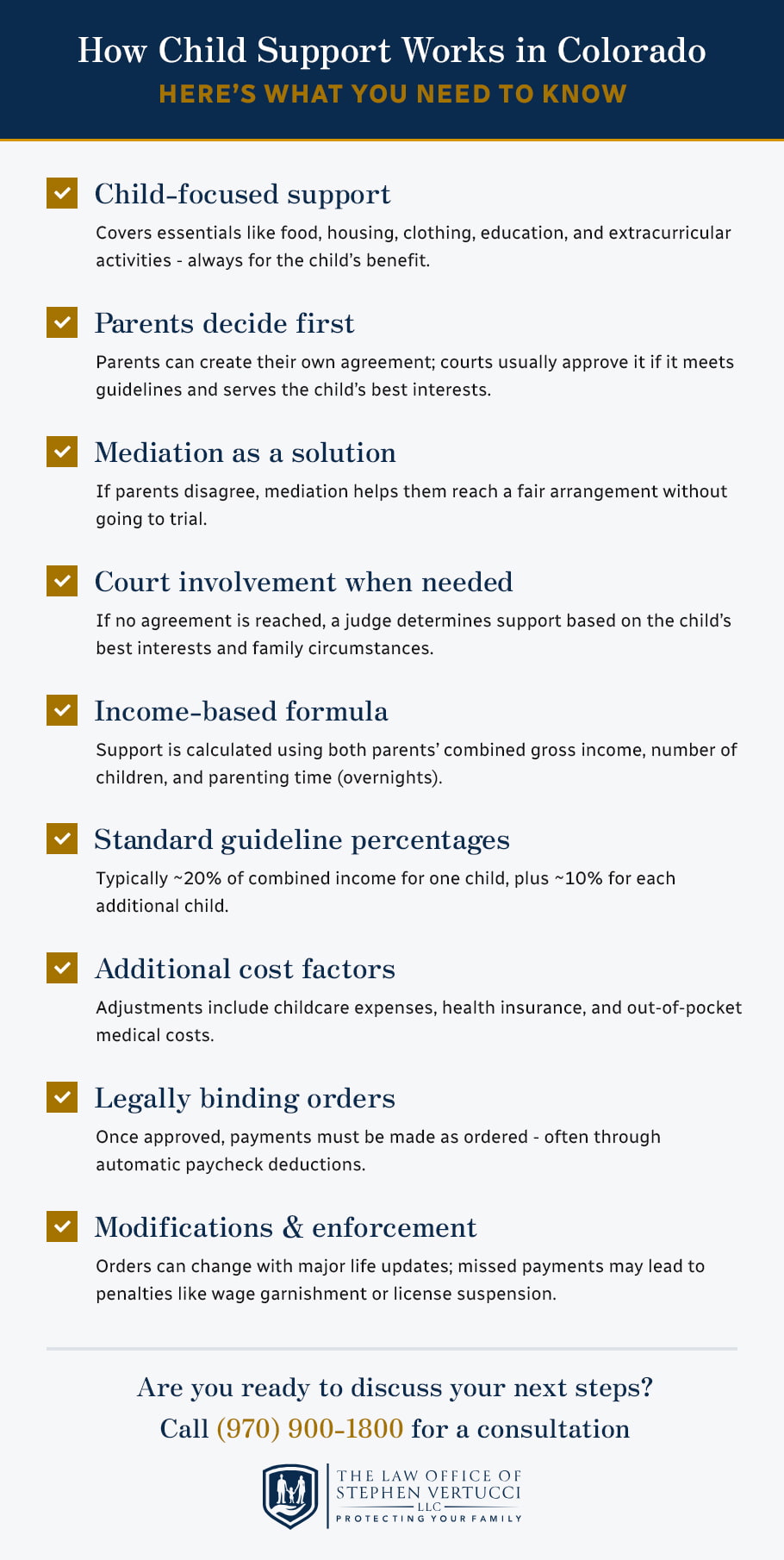
Child support is for the child, not for the receiving spouse. In general, child support covers a child’s basic needs, including education, clothing, food, and housing. However, it may also help a child enjoy a richer childhood by paying for extracurricular activities such as sports, camps, or music lessons. The courts may award child support to one spouse if he or she has primary custody of the kids and not enough income to continue the same level of care. If the noncustodial spouse is the main breadwinner, for instance, he or she may owe the custodial spouse money in child support after the divorce.

You Get the First Say
The courts in Colorado will first allow you and your spouse to work out a child support agreement before intervening. If you and your child’s father or mother can work together to come up with a custody and support agreement you both accept, a judge will most likely sign off on whatever you decide, unless the judge does not believe your agreement follows the state’s guidelines or is in the best interest of the child.
If you have trouble communicating or negotiating with your ex-spouse, the best way to agree is through mediation. Mediation is a chance for you both to list your grievances and hear the counsel of an unbiased third party. The judge during mediation can help you come up with a child support amount and payment strategy that works for both of you to help you avoid going to trial. Here is a helpful checklist of things to bring to mediation. If your spouse refuses to offer child support or work with you, however, you may need to go to court.
The Courts Determine a Support Award
A child support matter will proceed to court in Colorado if you and your spouse fail to create an agreement during pre-trial negotiations. During a divorce trial, a judge will assess your family’s dynamic, both spouses’ incomes, and many other factors to determine child custody and support. The main factor a judge will look at, however, is the child’s best interest. The goal of child support will be to maintain the child’s standard of living after the divorce.
Colorado’s child support statutes aim to ensure all children of divorced couples continue to receive adequate financial and emotional support from both parents. The courts will determine how much the noncustodial parent must pay the other parent in child support based on a complex state equation plus factors such as each parent’s financial resources, the child’s standard of living before the divorce, and the child’s needs. A child support order may include money for medical care, disability, education, and health insurance.
Colorado’s child support equation combines both parents’ gross incomes, as well as any money from retirement plans and public assistance, and takes a percentage to use as child support. Colorado typically deducts 20% of both parents’ combined gross incomes for one child and an additional 10% for each subsequent child, then splits the amount between both parties according to numerous factors.
If both parents make $100,000 together, for instance, and have four kids, the courts would split $40,000 (40%) between the two parents to support the children. In general, the noncustodial parent will have to pay the custodial parent his or her portion.
Steve Vertucci has dedicated his entire legal career to family law, helping clients through some of the most difficult times in their lives with thoughtful strategy and passionate advocacy.


What Factors Actually Influence Child Support in Colorado
Colorado courts weigh several variables beyond a paycheck. Under Colorado law, the following factors shape the final child support obligation:
- Gross earnings: From both parents, including wages, bonuses, and self-employment income
- Number of overnights: Each parent holds per year, which directly affects each parent’s share of the obligation
- Childcare costs: Tied to employment or job search activities
- Health insurance premiums: Paid on behalf of the children
- Significant out-of-pocket medical costs: Not covered by insurance
A parent who maintains health insurance coverage for the children may receive a credit that reduces that parent’s share of the total obligation. Even modest adjustments to a custody schedule can shift how much each parent owes. Parents who want a deeper answer to How does child support work in Colorado? can find a detailed breakdown in our blog post, Calculating Child Support in Colorado.
What Happens After Child Support Is Ordered
A child support order becomes legally binding the moment a judge signs it. The paying parent must follow the schedule and payment method the order lays out. Many Colorado families use income withholding, a process where the support amount is deducted automatically from the paying parent’s paycheck.
Payments flow through the Colorado Family Support Registry, the state’s official child support payment center, which maintains a verifiable record for both parties and the court.
When Child Support Can Be Modified or Enforced
Modification becomes available when a significant, ongoing change in circumstances occurs. A meaningful income change, a shift in the number of overnights, or a child’s evolving medical or educational needs all qualify as grounds.
Our post How to Modify a Child Support Order in Colorado outlines each step of the process. When a parent falls behind, Colorado enforcement tools include wage garnishment, license suspension, and contempt proceedings, which can result in court-ordered penalties.
Unsure About Your Child Support Options? Get Straightforward Advice From The Law Office of Stephen Vertucci, LLC
Child support orders are not always final, and changes in income, parenting time, or a child’s needs can affect how much is owed or received. Understanding how support is calculated and when it can be modified is key to protecting your financial stability and your child’s well-being.
Speaking with The Law Office of Stephen Vertucci, LLC can help you evaluate your situation and understand the next steps. To discuss your case, call us at (970) 446-5742.
Steve focuses exclusively on family law and brings over a decade of litigation experience to every case. He’s known for providing thoughtful strategies and passionate advocacy in high-conflict divorce and custody matters.
Stephen Vertucci
Founding Attorney

This page has been written, edited, and reviewed by a team of legal writers following comprehensive editorial guidelines. This page was approved by Founding Attorney Stephen Vertucci, who has more than two decades of litigation and family law experience.