

Law Attorneys Get Started Today
Restraining Orders vs. No Contact Orders: Key Differences
Key Takeaways
- A restraining order is generally requested through a civil court proceeding.
- A no-contact order is usually imposed as part of a criminal case.
- Colorado civil protection orders may be temporary or permanent.
- A criminal no-contact order generally remains effective until the criminal case reaches its final disposition or the court changes it.
- Only the court can modify or dismiss either type of order.
- Violating either order can result in arrest, criminal charges, or contempt of court.
Restraining orders and no-contact orders can both restrict communication and physical contact between two people. However, they arise under different legal circumstances and may remain in effect for different periods. If either type of order affects your marriage, parenting arrangements, or divorce proceedings, a Fort Collins divorce lawyer can help you understand how the restrictions may impact your rights.
A restraining order, commonly called a civil protection order in Colorado, is generally requested by someone seeking protection from threats, harassment, stalking, abuse, or violence. A no-contact order is typically imposed as part of a criminal case and restricts a defendant from contacting an alleged victim or witness.
Understanding the differences between restraining orders and no-contact orders is especially important when either order overlaps with a divorce, child custody dispute, or other family law matter.
Divorces and Legal Enforcement in Fort Collins
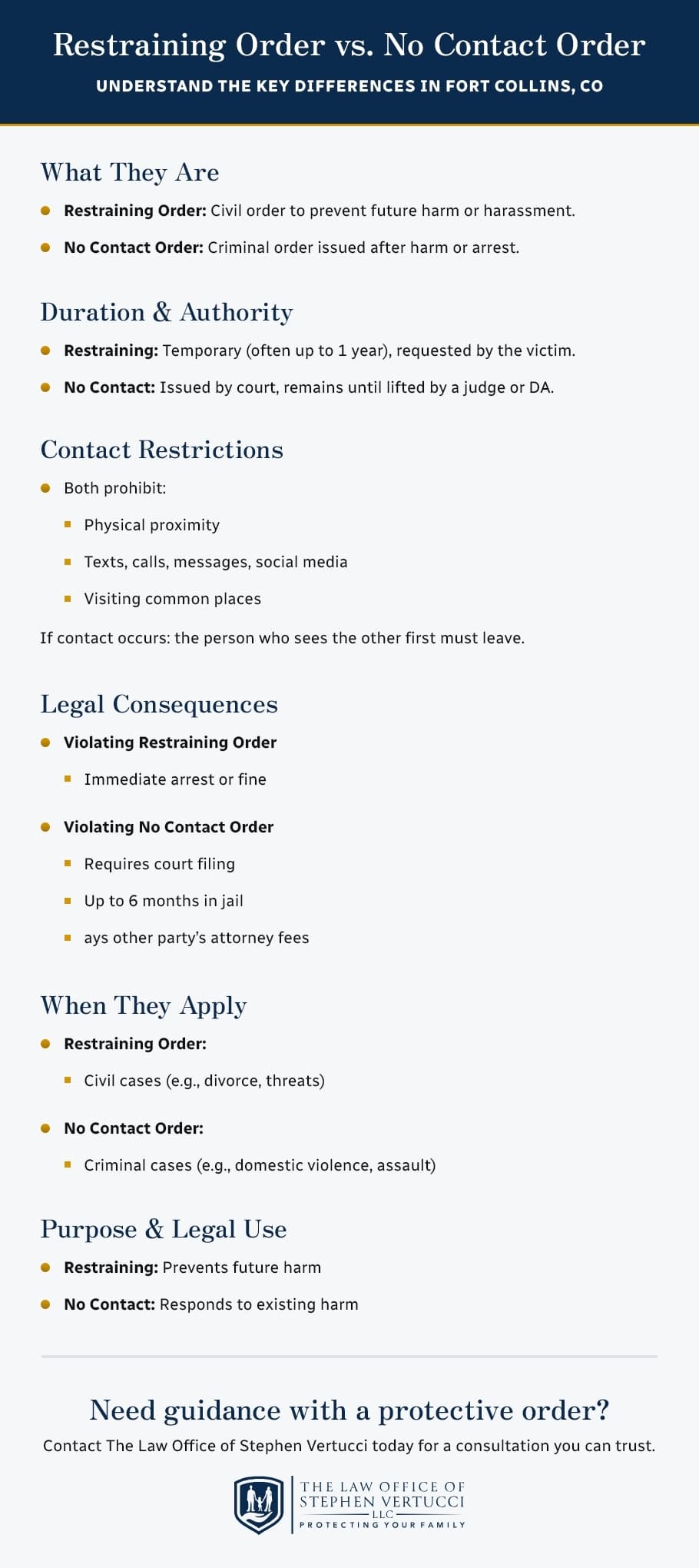
Divorces in Fort Collins vary greatly in nature, reason, and repercussions. Some divorces may even result in one of the spouses wanting official, legal reinforcement to keep the ex-partner away. Such reinforcement could be in the form restraining orders or no contact orders. These orders keep one spouse away from the other, as well as away from places that the requesting spouse frequents often. They may also ban texting, calling, messages, or any social media contact. If the two people accidentally run into each other, the person who was there last or who saw the other first is required to immediately leave. In the event you need legal counsel regarding a restraining or no-contact order in your divorce, contact our Fort Collins divorce lawyers today.
When divorce disputes involve restraining orders or no-contact agreements, working with a Windsor divorce lawyer can help ensure your rights are protected and that any court-ordered restrictions are handled correctly under Colorado law.
Contact a Fort Collins Divorce Lawyer
Consequences of Violating Restraining Orders and No-Contact Agreements
For a restraining order, if the restrained individual attempts to contact the other or violates the order in any way, he or she can be arrested or fined. However, when someone violates a no-contact order, the one who is violated is not permitted to immediately enforce action by the police. Such a case would require filing a citation with the court. Though the initial punishment seems less severe with no-contact orders, they incur more intense final punishment than restraining orders. If a no-contact order is violated, the violator may spend up to six months in jail. This individual would also have to pay the attorney fees for the other party.
Circumstances Leading to Restraining Orders vs. No-Contact Agreements
Yet another difference between a restraining order and a no-contact agreement is the circumstance that requires such action. A restraining order is usually filed for civil reasons such as divorces, relationships that ended poorly, or any other situation where a person feels threatened. A no-contact order is usually upheld because of criminal reasons. For example, if the victim of a crime were testifying against the criminal in court, they would most likely file a no-contact agreement that would last through the trial and even afterward. Often, criminal charges must be filed already or be in process for a judge to order a no-contact agreement.
Legal Considerations and Protective Measures
The laws on restraining orders and no-contact agreements vary by state, but the main idea is that no-contact agreements exist to punish someone who has already caused harm and to prevent further harm, whereas restraining orders exist to prevent someone from causing harm in the first place. Restraining orders can also be adjusted depending on the situation at hand and how threatened the person who filed the order currently feels.
Restraining Orders vs. No Contact Orders
Overall, both restraining orders and no contact orders serve to protect individuals from harm, but they have distinct purposes and legal processes. A restraining order is typically a civil court order requested by someone who feels threatened or harassed by another person. These orders can address various forms of abuse, including physical violence, harassment, or stalking. They may also include provisions for child custody, financial support, or property use, depending on the situation.
On the other hand, a no contact order is a criminal court order issued as part of a criminal case, often following an arrest for domestic violence, assault, or other crimes. This order prohibits the defendant from having any form of contact with the victim while the case is ongoing. No contact orders are not requested by the victim but are instead issued automatically by the court to protect the victim during criminal proceedings.

Speak With a Fort Collins Family Law Attorney
Restraining orders and no-contact orders both restrict contact, but they arise through different legal processes. A civil protection order is generally requested by someone seeking protection, while a criminal no-contact order is imposed by a court in connection with criminal proceedings.
When either type of order affects a divorce, parenting dispute, or access to the family home, obtaining legal guidance can help you understand the restrictions and avoid an unintended violation.
Contact our Fort Collins family law attorneys to discuss how a restraining order or no-contact order may affect your rights and responsibilities under Colorado law. Call us at (970) 900-1800 today.
Steve Vertucci has dedicated his entire legal career to family law, helping clients through some of the most difficult times in their lives with thoughtful strategy and passionate advocacy.



This page has been written, edited, and reviewed by a team of legal writers following comprehensive editorial guidelines. This page was approved by Founding Attorney Stephen Vertucci, who has more than two decades of litigation and family law experience.