

Child Support vs Custody: Key Differences Explained
While distinct legal concepts, child custody and child support both aim to protect a child’s well-being after parental separation or divorce. Custody defines parental rights and responsibilities regarding living arrangements and decision-making, while support focuses on financial contributions to meet daily needs.
At The Law Office of Stephen Vertucci, we regularly guide families through the complex realities of divorce in Fort Collins. One of the most common areas of confusion is the difference between child support vs custody, two legal components that are deeply intertwined but serve separate functions in family law.

Understanding the Basics: Child Support vs Custody
Legal matters involving children after a divorce often fall into two primary categories: financial obligations and parental authority. These areas intersect but are not the same, and understanding the core differences between child support vs custody is essential when navigating family law in Colorado.
Custody addresses who has the right to make decisions for the child and where the child will live, while support ensures both parents contribute to the child’s financial needs. These legal concepts are separate in definition and purpose, yet they work together to protect the child’s best interests.
Knowing this distinction early in the divorce or separation process can help parents create a more stable environment and avoid unnecessary disputes. When each party understands their specific duties and rights, whether that involves time-sharing, decision-making, or financial contributions, families can better collaborate on parenting plans that reflect the child’s needs and comply with Colorado law.
Contact a Fort Collins Divorce Lawyer
What Is Child Custody?
In Colorado, child custody is legally defined as “parental responsibilities” and is broken down into two main areas: physical and legal custody.
- Physical custody determines where the child lives and how much time they spend with each parent.
- Legal custody grants one or both parents the authority to make key decisions about the child’s education, healthcare, and overall welfare.
Colorado courts promote cooperative parenting and typically favor arrangements where both parents share responsibilities, as long as it serves the child’s best interests. When building a parenting plan, families may need to:
- Create a parenting schedule that outlines when each parent has the child.
- Decide how important life decisions will be made.
- Calculate appropriate child support payments.
- Designate which parent will provide health insurance coverage.
- Determine who will claim the child on tax returns.
These elements help ensure a comprehensive plan that addresses the child’s physical, emotional, and financial needs. As outlined by Colorado Law Help, these responsibilities are part of the broader framework courts use to guide custody arrangements in the state.
Comprehending how child custody decisions intersect with financial obligations gives parents a clearer picture of how child support vs custody is addressed during divorce proceedings in Colorado.
Key Differences Between Custody and Support
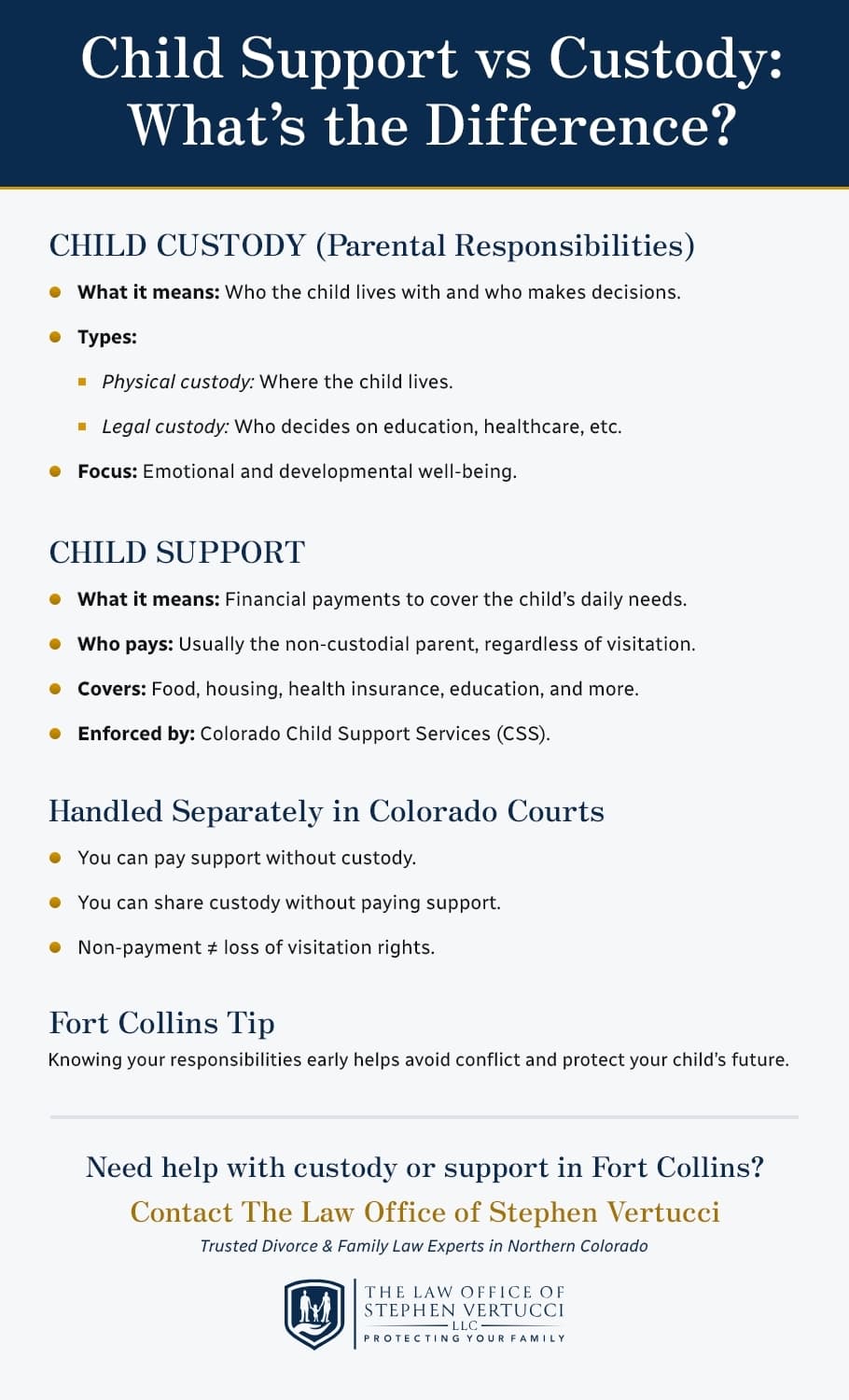
Although custody and child support often arise during a divorce, they have separate legal definitions and outcomes.
- Custody relates to decision-making and time allocation.
- Support pertains to financial contributions.
For instance, a parent with primary physical custody may spend more time with the child, but both parents typically share legal custody. Meanwhile, child support payments may be required from the non-custodial parent, regardless of how often they see the child.
Custody decisions prioritize the child’s emotional, physical, and developmental needs, while support obligations ensure that the child’s financial needs are consistently met. This distinction allows Colorado courts to balance the child’s welfare with the parents’ responsibilities.
Recognizing the difference between child support vs custody is crucial when preparing legal agreements that reflect both financial and parenting responsibilities.
How Colorado Courts Handle Custody and Support
In Colorado, the family courts strive to keep children in stable environments, emotionally and financially. Custody is determined based on the “best interests of the child” standard, which may include factors such as:
- The child’s emotional ties to each parent.
- Each parent’s ability to care for the child.
- The child’s adjustment to home, school, and community.
- Any history of abuse or neglect.
On the other hand, child support is calculated using a formula based on parental income and other factors, such as health insurance, childcare costs, and time spent with the child. To enforce support, the Colorado Child Support Services (CSS) Program uses several tools, including the following:
- Credit bureau reporting.
- Tax refund intercepts.
- Driver’s license and recreational license suspensions.
- Wage garnishment and payment monitoring.
CSS oversees statewide compliance, while local county offices manage individual support cases. Parents must apply through their county office to initiate a case.
Can You Have One Without the Other?
Yes, child support and custody can be legally separate matters. A parent may be ordered to pay child support without physical or legal custody. Conversely, a parent may share custody but not be obligated to pay support if financial circumstances don’t warrant it.
It’s also important to note that failure to pay child support does not give the other parent legal grounds to withhold visitation. Likewise, refusing parenting time does not eliminate financial obligations. Each issue is enforced separately to protect the child’s rights and needs.
Steve Vertucci has dedicated his entire legal career to family law, helping clients through some of the most difficult times in their lives with thoughtful strategy and passionate advocacy.


What to Do If You’re Facing a Custody or Support Dispute in Fort Collins
If you’re going through a divorce or custody battle in Fort Collins, it’s critical to understand your legal rights and obligations from the beginning. At The Law Office of Stephen Vertucci, we help parents:
- Clarify what legal and physical custody mean in your specific situation.
- Accurately assess financial responsibilities.
- Create workable parenting plans.
- Prepare for hearings or mediation sessions.
Navigating these matters alone can be overwhelming. Laws and procedures vary by county, and mistakes can have long-term consequences for you and your child. That’s why it helps to have a team solely focusing on divorce and family law in Northern Colorado. This is also a good time to review the top 10 questions to ask a divorce lawyer to ensure you’re fully prepared before moving forward.
Talk to a Fort Collins Divorce Attorney Today
You don’t have to figure this out alone. Whether you’re seeking clarity on child support vs custody, revising a parenting agreement, or navigating the enforcement of existing orders, The Law Office of Stephen Vertucci is here to help. Our firm provides knowledgeable, compassionate legal representation tailored to the needs of families throughout Fort Collins and Northern Colorado.
Take the first step toward protecting your rights and securing your child’s future. Call (970) 900-1800 today to schedule a consultation with a trusted Fort Collins divorce attorney.


This page has been written, edited, and reviewed by a team of legal writers following comprehensive editorial guidelines. This page was approved by Founding Attorney Stephen Vertucci, who has more than two decades of litigation and family law experience.